
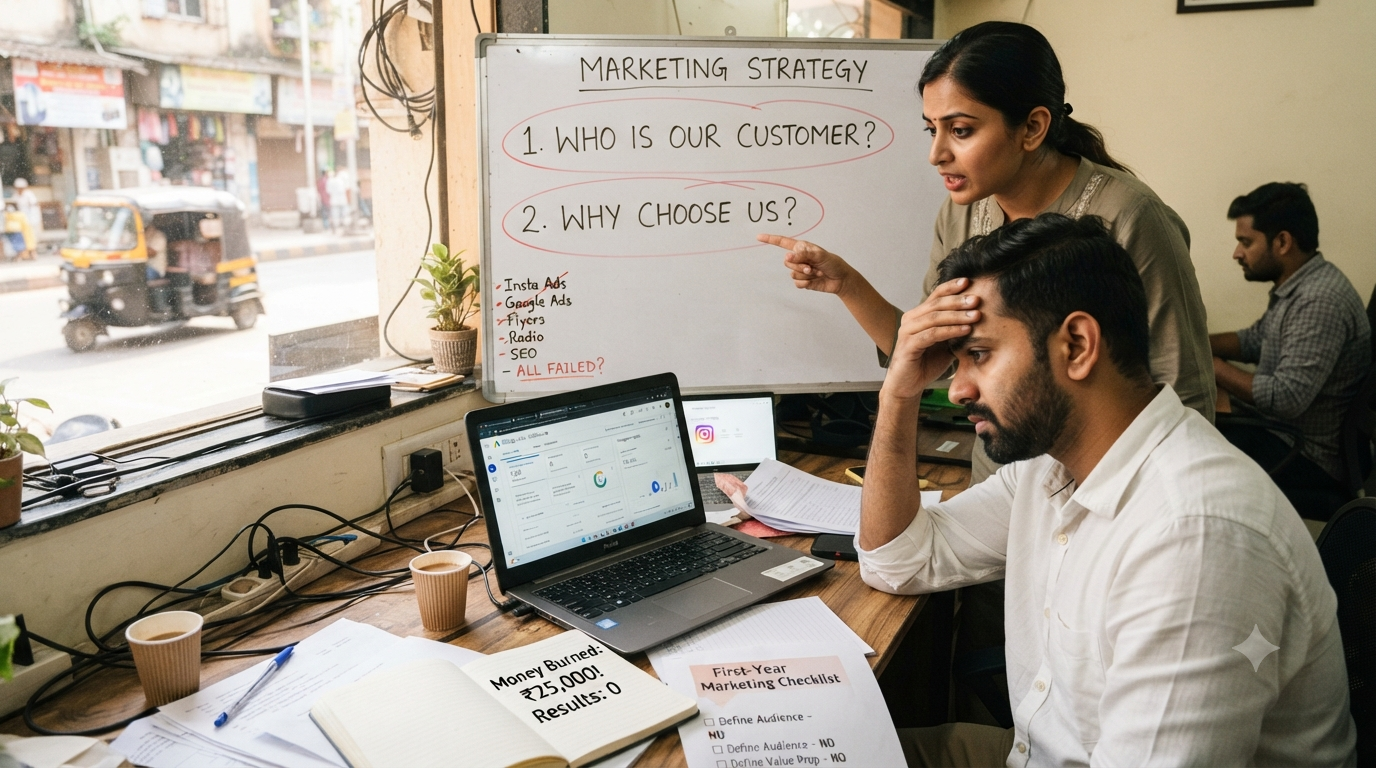
Biggest Marketing Mistake Small Businesses Make in Their First Year
Ask ten small business owners about their first year and most will mention long hours, tight budgets, and marketing that felt like throwing money into the wind. After working with dozens of small businesses, one pattern shows up again and again. The biggest marketing mistake small businesses make in their first year is starting to spend on ads and promotion before they have a clear idea of who they are selling to and why someone should choose them.
Quick Answer
The single biggest first-year marketing mistake is running campaigns before defining a target audience and a clear value proposition. Without that foundation, every rupee spent on ads, social media, or content works harder than it should and delivers weaker, inconsistent results.
Table of Contents
- The Real Mistake, Explained
- Why This Happens So Often
- Other Common First-Year Mistakes
- How to Fix It
- First-Year Marketing Checklist
- Key Takeaways
- FAQs
The Real Mistake, Explained
Most first-time business owners are eager to get customers fast, which is understandable. So they launch a Google Ads campaign, or start boosting Instagram posts, before they have answered basic questions: who exactly is the ideal customer, what specific problem does the business solve better than competitors, and what should the customer feel or think after seeing an ad. Without those answers, marketing becomes guesswork dressed up as strategy.
This is different from having weak branding, though the two are related. A business can have a decent logo and still not know who it is actually trying to reach, which is what causes campaigns to underperform even when the creative looks fine.
Why This Happens So Often
- New business owners feel pressure to show activity and results immediately
- Marketing platforms make it easy to launch a campaign in minutes, with no strategy required
- Budgets are tight, so owners want to skip “planning” and go straight to “doing”
- There is often no one in-house with marketing experience to slow the process down and ask the right questions first
Other Common First-Year Mistakes
- Trying every platform at once. Spreading a small budget across five platforms usually means doing none of them well.
- Ignoring SEO entirely in year one. SEO takes months to build, so delaying it means starting the clock late.
- No way to track what is actually working. Without basic tracking, it is impossible to know which channel is driving real results.
- Copying a competitor’s marketing instead of building a distinct position. This makes it harder for customers to see why they should choose the new business over an established one.
- Expecting fast results from every channel. Paid ads move fast, but SEO and brand-building take months, and expecting instant results from all of them leads to premature panic and channel-switching.
How to Fix It
The fix is not complicated, but it does require patience in the first few weeks. Before spending on any promotion:
- Write a clear, specific description of your ideal customer: who they are, where they are, what they need
- Define one clear reason a customer should choose you over the next option they consider
- Choose one or two channels to focus on first, based on where your specific customers actually spend time
- Set up basic tracking so every rupee spent can be traced to a result
- Start SEO and content early, even in a small way, since it compounds over time
First-Year Marketing Checklist
- ☐ Write a one-paragraph description of your ideal customer
- ☐ Define your core value proposition in one sentence
- ☐ Pick 1 to 2 marketing channels to focus on, not five
- ☐ Set up basic analytics and lead tracking before spending on ads
- ☐ Start content and SEO work in month one, not month twelve
Key Takeaways
- The most damaging first-year mistake is skipping audience and positioning clarity before spending on marketing.
- Spreading a small budget across too many channels usually performs worse than focusing on one or two.
- SEO started late means results arrive late. Starting early, even modestly, pays off by year two.
- Tracking results from day one prevents months of guessing what is actually working.
Conclusion
The biggest marketing mistake small businesses make in their first year is not a bad ad or the wrong platform. It is skipping the groundwork of knowing exactly who they are speaking to and why that person should care. Slowing down for even a week or two to answer those questions properly usually saves months of wasted spend later. If your first year of marketing has felt scattered, going back to those basics is often the fastest way to turn things around. For more on why campaigns underperform even with a decent budget, see our guide on why small business websites fail to rank on Google.
Frequently Asked Questions
1. What is the biggest marketing mistake small businesses make in year one?
Starting to spend on ads and promotion before clearly defining the target audience and value proposition.
2. Should a new small business focus on paid ads or SEO first?
Ideally both, in parallel, since paid ads bring faster results while SEO builds long-term traffic that compounds over time.
3. How much should a first-year business spend on marketing?
There is no universal number, but many small businesses in India start with a focused monthly budget on one or two channels and scale up as results come in.
4. Why do first-year marketing campaigns often underperform?
Usually because they launch without clear audience targeting, a defined value proposition, or a way to track what is working.
5. Is it a mistake to try every marketing channel in year one?
Yes, in most cases. Spreading a limited budget across too many channels usually means none of them get done well enough to work.
6. How long does it take to fix a weak first-year marketing strategy?
Clarifying audience and positioning can happen within a week or two. Seeing improved results typically takes 60 to 90 days once the new approach is in place.
Written by the team at Biznex, a digital marketing agency based in Borivali, Mumbai, working with first-time business owners on strategy, branding, and growth.
Follow Biznex: Instagram | Facebook | LinkedIn | YouTube
References: American Marketing Association, U.S. Small Business Administration: marketing and sales guide.